The next few months will be eventful for shaping the future of Colorado’s growth. Denver’s first Bus Rapid Transit (BRT) opened last month on East Colfax. In November, voters along the Front Range will decide whether to fully fund the Front Range passenger rail line, the Colorado Connector (CoCo). And by the end of the year, 32 Front Range cities and counties must submit a report to the state showing they’re planning for more housing near frequent transit corridors to comply with House Bill 24-1313, the state’s Transit-Oriented Communities (TOC) law.
These are all part of a broad set of changes the state has made, mostly over the last three years, to advance affordability and sustainable growth, with major policy shifts across housing, transit, planning, and public finance. Many of these were adopted separately and for their own reasons, but together they stack and reinforce each other.
This comes at a time when the status quo growth model, much in the form of urban sprawl, is under strain. Road funding hasn’t kept up with the demand induced by outward growth. Water constraints, air quality problems, and climate pressures are mounting, and Colorado lost more farmland than any other state from 2017 to 2022. Sprawling development requires costly new infrastructure (roads, pipes, and utilities) and services (fire stations, schools, and libraries). Yet with few homes or jobs per acre, it generates too little tax revenue to cover those costs – shifting the long-term burden onto taxpayers and future residents. Xcel Energy’s recently approved $2 billion wildfire mitigation plan is a reality check on the physical and fiscal risks of sprawling low-density development in high wildfire risk areas; the cost of mitigating these risks shows up on every ratepayer’s bill.
Our view is that the pieces are now in place for Colorado’s next round of growth to be more affordable and sustainable than the last. How much of this is realized depends largely on whether Colorado’s state and local governments seize the opportunity to partner on smarter growth, especially as a new governor takes office.
This post unpacks each of these pieces and explains how they fit together:
- How the pieces reinforce each other, and recommendations for local governments
- New state funding for transit-oriented places
- Land use and zoning reforms that allow more housing to get built
- The transit projects that funding is built around

Section 1: New state funding for transit-oriented places
The newest and least-understood portion of this growth framework is the state money. Over the last three years, the state has committed substantial funding to communities that build compact, transit-oriented neighborhoods.
A new financing tool: Tax Increment Financing (TIF) for Transit-Oriented Development (TOD)
Potentially hundreds of millions of dollars spread across 6 districts over the next 30 years.
This new law, Transit and Housing Investment Zones (HB26-1065), lets locally-designated TOD districts use TIF to keep a portion of the growth in state sales tax revenue generated within the district for 30 years. Local governments apply for the designation and the state’s Office of Economic Development and International Trade (OEDIT) is the approval authority. Districts can then spend the revenue on TOD-enabling infrastructure, broadly defined to include bike and pedestrian infrastructure, public plazas, streets and parking, landscaping, lighting, and more.
This concept is that public investments in the district will generate new economic activity that wouldn’t otherwise happen, such as new apartments, hotels, stores, and restaurants. The revenue share that the state gives up only exists if that development succeeds.
A simplified hypothetical: Suppose Winter Park creates a TIF district near the Mountain Rail station. Passenger rail service from Denver attracts more visitors around the station area, and a few hotels, restaurants, and ski shops open and generate $50 million per year in new taxable sales at full buildout. At the state’s 2.9% sales tax rate, this would generate $1.45 million per year under the TIF designation, money the city can use to pay for the infrastructure needed to support new businesses and housing. This creates a new town center where more people can get from lodging to shopping to skiing without needing a car.
Affordable housing tax credits near transit
$500 million through 2033.
Two laws provide new state Affordable Housing Tax Credits (AHTCs) to transit areas:
- HB26-1065 provides $350 million in AHTCs for projects within 2 miles of transit or passenger rail stations, awarded at $50 million per year from 2027 to 2033. The state will release maps of eligible areas in October, 2026.
- HB24-1434 provides $150 million in AHTCs for projects in cities and counties subject to the state TOC law over a five year period. 80% of that total ($120 million) is contingent upon state certification of compliance with the state TOC law, HB24-1313, and allocated in 2028 and 2029.
State tax credits typically cover somewhere between 10% and 20% of what it costs to build an affordable home, or roughly $30k-$75k per unit depending on the deal. At a rough average of $50,000 per unit, these credits can support about 10,000 affordable homes near transit, while catalyzing additional private development nearby.
Prop 123 Affordable Housing Financing Fund
Variable, $200 million generally, temporarily reduced to $159 million in 2027.
The largest share of Prop 123 funding (60%) finances new affordable rental housing through OEDIT and the Colorado Housing and Finance Authority (CHFA). It prioritizes projects near frequent transit using the HB 24-1313 definition, and requires that they be high density, or the maximum allowable under local zoning.
Aligning State Investments: Prioritizing Grants for Communities That Follow State Land Use Laws
Governor Polis’s 2025 Executive Order directs state agencies to prioritize discretionary state grants to jurisdictions that comply with the state’s land use laws to maximize the impact of state funds on affordability and sustainability. In the current fiscal year, this amounts to about $220 million in grants, including $11 million for electric vehicle charging and $4.8 million for sustainable housing. The state tracks compliance on this dashboard. For a full list of programs, see the appendix at the bottom of this post.
Front Range Passenger Rail station area funding
$40 million per year for 25 years (contingent on the November ballot).
If voters approve the Front Range Passenger Rail funding measure this November, the district’s delivery plan outlines annual funding to each of the 12 host communities to plan and build out their station areas. In addition to the rail infrastructure, the proposal includes a “local return” to host cities that adds up to $1.5 billion over 25 years. Allocations are tiered by population as shown here.

TOC Infrastructure Grants
The state TOC law includes $35 million in TOC infrastructure grants for upgrades that enable affordable housing near transit. The first round provided $4 million for Longmont’s downtown transit hub, consisting of 10 bus bays, bike and scooter parking and more, and $4 million for Denver’s Broadway Station pedestrian bridge connecting RTD’s I-25 and Broadway station with the future Summit FC soccer stadium and surrounding developments. About $20 million remains for a 2027 funding round and is available for communities that demonstrate compliance with HB 24-1313.

Longmont’s Downtown Transit Hub at 1st & Main, future home of the Colorado Connector (CoCo) rail station, was awarded a $4 million TOC Infrastructure grant in February 2026.
Local and federal fund layer
While this post focuses on state support, it’s worth noting that many cities are already putting their own money into walkable, transit-oriented districts through downtown development or urban renewal authorities, bond packages, and annual budgets. For example, voters recently expanded the Downtown Denver Development Authority’s boundaries and approved $570 million in TIF-financed bonding authority. It has already awarded over $100 million for 4 office-to-residential conversions targeting about 1,100 homes, with a mix of income-restricted and lower-cost market-rate units. Aurora voters approved a Downtown Development Authority in 2025. New federal Opportunity Zone designations are being selected now, and all Denver Mile High Line sites are included in the state’s proposal for their infill and TOD potential. State money will stack on top of these funds, not replace them.
Section 2: Land use and Zoning
Transit and funding are important conditions for homes to be built efficiently, but they still rely on local rules to allow them. A set of recent state laws remove some of the most common barriers: zoning that doesn’t allow more housing near stations, slow and unpredictable approvals, and parking mandates and building codes that make it harder for apartments to pencil out.
Colorado’s Transit-Oriented Communities (TOC) law (HB 24-1313)
The TOC law is the core of this framework. It requires 32 Front Range jurisdictions with frequent transit to zone for meaningful housing density near it, and a key deadline arrives at the end of this year. The law has three main components:
- A zoning capacity target. Each community calculates a Housing Opportunity Goal, based on the amount of land near rail stops and frequent bus routes, and must zone for a capacity of 40 homes per acre averaged across that land (the threshold generally needed to support frequent transit). Any zoning near transit that allows at least 15 homes per acre counts toward the goal, so communities can meet it with a mix of housing types: apartments near stations, townhomes, duplexes, or smaller lot homes with ADU allowances. The law doesn’t require any specific parcel to be changed, so local governments have the flexibility to upzone certain areas while leaving others unchanged or low-density. Englewood, for example, plans to count single-family lots that allow two ADUs toward compliance.
- Streamlined approval. Near transit, communities must approve multifamily projects on parcels of five acres or less administratively, using objective standards rather than discretionary public hearings. Housing needs assessments consistently find that lengthy and unpredictable review adds time and cost. Research finds that administrative approval speeds development approvals by up to 28% on average.
- Affordability and antidisplacement strategies. Each community must choose and adopt strategies from a menu of opportunities published in state guidance. Options include allowing for diverse housing types like rowhouses and triplexes, right-sizing impact fees, fast-tracking affordable housing approvals, rental assistance, and eviction legal defense.
Final reports to the state are due at the end of 2026. To be certified as compliant, reports must include evidence that zoning capacity meets the housing opportunity goal, and that cities have adopted affordability and antidisplacement strategies. Jurisdictions can be certified for compliance at this stage, boosting funding eligibility immediately, or they may finalize required elements after submitting the report and before the final certification deadline at the end of 2027.

Source: Department of Local Affairs’ TOCs Calculation Model Webinar
Funding stakes.
Local governments that don’t comply with HB24-1313 will lose access to:
- $120M in TOC tax credits for affordable housing, allocated in 2028 and 2029 under HB24-1434
- $35M in TOC infrastructure grants through 2027, created by HB24-1313
- $220M in prioritized state grants under the Strategic Growth Compliance Framework (see appendix for the full list)
For most communities, the law lines up with what they are already trying to do. Nearly every city in the Denver region is working on a walkable town center or TOD district somewhere. This includes Downtown Westminster, Broomfield’s Flatiron Crossing, Littleton’s Mineral Station, Centennial’s Midtown, Englewood’s CityCenter, Thornton’s shopping center redevelopment, Lone Tree’s RidgeGate, Longmont’s 1st and Main station area, and Boulder Junction, among others.
These predate the TOC law, but the law and its incentives can help bring them to completion and lay the groundwork for others.
Reforms that lower building costs and unlock more housing supply
Zoning, parking, and building code reforms can lower the cost to build, which will allow rents to be lower and public funds to go further.
- Parking reform (HB24-1304). Excessive parking requirements take up land that could otherwise be used for homes. Structured parking can cost upward of $50,000 per spot to build, which is reflected in higher rents. This law prohibits minimum parking requirements for multifamily housing near frequent transit, allowing builders to decide how much to provide. At least 21 Front Range jurisdictions, home to about 2 million people, have eliminated these mandates, while many communities including Longmont, Boulder, Denver, and Wheat Ridge have gone beyond the state requirements.
- Single stair buildings (HB25-1273). Building codes have generally required two stairways in apartment buildings above three stories. Advances in fire prevention embedded in modern building codes make the extra exit unnecessary for fire safety, freeing up floor area for more homes, while allowing better layouts and making smaller lots feasible. Colorado cities of 100,000 or more must allow apartment buildings up to at least 5 stories with a single staircase by December 1, 2027.
- HOME Act (HB26-1001). This law requires cities to allow denser housing through administrative approval on sites up to 5 acres owned by housing authorities, school districts, colleges, transit districts, and nonprofits that build housing. For TOD, this opens up housing opportunities on underused park-and-rides and land near stations.
Section 3: Transit is expanding across the state
The backbone of TOD is high quality transit, and Colorado is undergoing its largest transit expansion in a generation. This includes intercity passenger rail, a network of bus rapid transit (BRT) lines, and new state money for local and regional bus service. These projects create the travel corridors, nodes, and anchors around which the TOD investments described above can land.
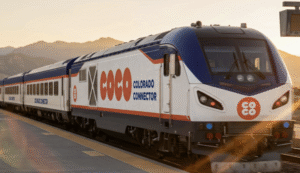
Front Range Passenger Rail, now styled the Colorado Connector (CoCo), is a proposed intercity rail connecting Fort Collins, Denver, Colorado Springs, Pueblo, and communities in between. It would serve the state’s largest population centers, connecting 12 stops with 8-10 daily round trips at full buildout. Each station is an opportunity to build a complete community; clustering housing, jobs, and services around a stop, thus making public investment go further toward delivering more affordable homes in livable, walkable communities, and giving private developers a reason to invest.
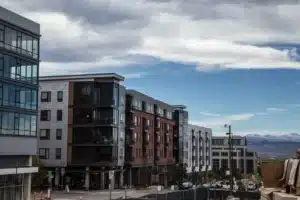
In November, voters in 31 cities along the corridor will decide on a 0.33% sales tax (3.3 cents on a $10 purchase). Service from Denver to Fort Collins is already planned for 2029 with 3 trips per day, and the tax would extend service south to Pueblo on existing tracks and increase frequency by 2032. Importantly, many of the future CoCo stations will be located in existing downtown areas, some of which have been encouraging compact, mixed-use development for decades in anticipation of a train from Denver to Longmont. For example, Downtown Westminster, Boulder Junction, and Longmont’s 1st & Main Street Station have welcomed thousands of new homes in the last 10 years, and have plenty of opportunities for more as they grow into thriving town centers.
Bus rapid transit (BRT) networks for the Denver Metro and beyond. BRT gives buses dedicated lanes, priority at traffic signals, and rail-like stations. The result is frequent, reliable service at a fraction of the cost of rail, embedded directly in the fabric of the city in existing population and job centers. Here are a few examples of BRT projects moving forward on the Front Range:
- East Colfax BRT. The first center-running dedicated bus lanes opened last month, and full BRT service with new buses and stations begins in 2027. The line will run about 9 miles from Broadway at Civic Center Station to the Aurora medical campus and I-225 / RTD R line with buses running about every 4.5 minutes. The Colfax buses are already on par with the A line to Denver’s airport with the highest ridership in RTD’s network at around 22,000 daily riders, anticipated to grow to nearly 36,000 by 2040 with BRT. The corridor passes through some of Denver’s densest, most walkable neighborhoods, and has substantial untapped housing capacity.
- Federal Boulevard BRT. This 18-mile line will run from Westminster to Englewood, through some of the region’s most diverse and transit-dependent neighborhoods. Construction is set to begin in 2027, with service in 2030. Denver has a TOD study underway now to evaluate housing opportunities along this route.
- Colorado Boulevard BRT will bring service from I-70 to Hampden and is being designed now.
- Fort Collins BRT: The 5-mile MAX line runs every 15 minutes between the city’s South Transit Center and Downtown, past CSU, on a dedicated lane for about 75% of its route, and is credited with spurring housing development. Expansion is underway.
- Diagonal Highway / CO119 BRT. Running from Boulder to Longmont, this line’s key feature is bus queue bypass lanes at signaled intersections, which let buses jump ahead of traffic that accumulates at red lights. It includes some dedicated lanes on Coffman Street in Longmont and upgraded stations along the route. Service begins in 2027.
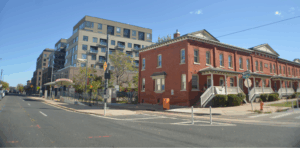
Colfax BRT is already attracting new housing development, with several projects underway or recently completed along the corridor. As cataloged by Denver Infill, the project is already showing evidence of stimulating over 1,000 new homes along Colfax, including:
- Route 40 (at Corona): 210 homes
- The Vixen (Marion): 334 homes
- Williams Workforce (Williams): 111 homes with only 32 parking spaces
- A building replacing the long-abandoned Royal Palace Motel (Colorado): 155 homes
- The Marlow (Elm): 205 homes

A new apartment building under construction above the recently opened East Colfax Bus Rapid Transit (BRT) corridor.
Mountain Rail. Passenger rail to Grand County is slated for expansion with one daily round trip between Denver and Granby with stops in Fraser and Winter Park. The long-term plan increases frequency and extends service to Steamboat Springs, Hayden, and Craig. The line offers an alternative to driving congested I-70 and Berthoud Pass, both for skiers traveling car-free and ski industry workers. Rail station areas in these mountain resort towns are natural sites for workforce housing and walkable town centers, where workers could live within walking distance of both the train and their jobs.
Expanding state support for local transit service through the Clean Transit Enterprise (CTE). A 2024 fee on oil and gas production (SB24-230) now supports local transit operations statewide to the tune of $116 million a year starting in 2027. It will arrive at an opportune time as RTD is exploring service cuts due to budget constraints. Recent transit expansions add to station area potential, including RTD’s N Line to Thornton, G Line through Olde Town Arvada and Wheat Ridge, and CDOT’s Bustang intercity bus network.
Section 4: How these reinforce each other, and recommendations for local governments
We now have a coordinated alternative to twentieth-century growth. Frequent transit service connects more cities and neighborhoods and is expanding across the state. Affordable housing tax credits, TIF districts, and prioritized state grants are directing hundreds of millions of dollars to places where public investments go furthest. Zoning, parking, and building code reforms allow builders to deliver more of the homes people want, at a lower cost.
Each component makes the others work better. Frequent transit allows neighborhoods to allocate more space to housing, local businesses, and public spaces instead of roads and parking for cars. Public investment brings residents and businesses, which justifies more frequent service, and TIF captures some of the value created and uses it to unlock more development opportunities. The result is more homes people can afford (most new Denver apartments already rent at or below the area median income), lower transportation and insurance costs for households, cheaper infrastructure for governments, and about half the driving compared to outward growth, and less pollution in our communities. Walkable neighborhoods already sell at a premium; these policies legalize and catalyze more of what people already want.
Recommendations:
- Local governments should fully implement the state land use laws. These laws reflect best practices in housing and land use, are proven to increase housing supply and lower costs, and line up with goals most communities already share: meeting housing needs, expanding transportation options, and building walkable town centers. They work best when applied consistently across a region rather than as a patchwork, and implementing them unlocks state funding described above.
- The state should keep supporting local implementation and aligning investments with TOD. This means continuing technical assistance and guidance for communities working on this, and continuing to direct tax credits, grants, and infrastructure funding toward projects and places that make transit-oriented housing possible. Rewarding communities that move first and furthest helps deliver results on the ground.
- State and local governments and transit agencies should keep expanding frequent transit where it can succeed. Transit is what makes these places work, and the best opportunities are in communities with the population and job density to support frequent service. New operating funds and the growing BRT and rail networks create a foundation to build on, and coordinating transit investments with zoning and funding tools will make each go further.
These investments phase-in as the transit projects listed in the third section come online and state strategic growth laws mature. Early affordable housing and infrastructure in TOD districts will bring residents and attract businesses and market-rate developers. A growing district gives transit agencies the ridership base and incentive to run more frequent service.
Appendix:
Full list of programs and amounts tied to local compliance with state land use laws: